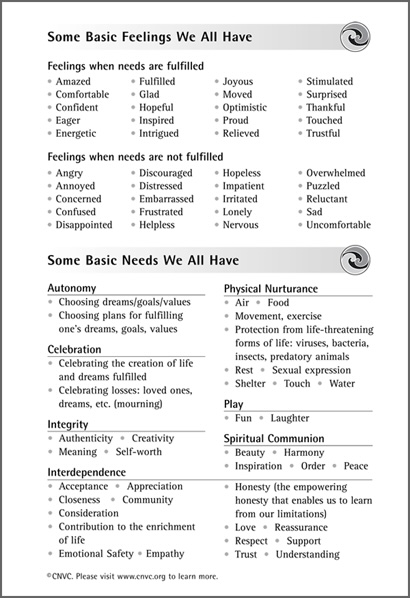
Nonviolent Communication teaches us that needs are requirements for any human life, and how to recognize our needs.
A list of basic human needs can be found both in Marshall Rosenberg’s book called Nonviolent Communication, and as well as online in various modified, updated or expanded NVC groups such as the list of needs emphasizing meaning and connection over integrity made in New York City. A basic premise in Nonviolent Communication philosophy is that too often we ignore our basic and needs and become preoccupied with the strategies we believe will fulfill them — while not even admitting we even have them — and that by recognizing our basic needs we can begin to live more peaceful and fulfilling lives.
Through the process of misdiagnosis, a kind of oppressive game (the phrase “oppressive game” is borrowed from Marshall Rosenberg’s writing), we’ve lost track of our real basic and human needs.
Frequently, as misdiagnosed persons, we have come to believe that the world simply does not have space for us to meet our needs for autonomy. Or, out of a sense of depression about our status as misdiagnosed, we have neglected to adequately care for our needs for rest, physical exercise, or nutrition. When we do meet our physical needs, in the situation of misdiagnosis, we are expected to be completely “better” and any sense that there are still unmet needs (in the categories of connection, meaning, integrity, or play, for example) can create spirals of feelings around our identity as misdiagnosed that are perceived negatively, thereby completing the loop of self-fulfilling prophecy and justifying our low status among those who would keep us involved in oppressive games.
At MA we do not tell each other what the other’s needs are. However, by witnessing and being in community with others whose stories are much like ours and who benefit from being open about how their needs (either met or unmet) relate to their feelings (positive or negative), we may start to have an easier time recognizing our needs and pursuing their fulfillment.
Many of us find that many connection needs (receiving as well as giving support, receiving as well as giving understanding) can be met through our interactions with MA members and attendance of MA meetings. It can be challenging as well (challenge is a need in the category of meaning according the NYC list) to meet with those when so much time and energy has been spent in the games of misdiagnosis to associate oneself with “people like that”. When we build trust and understanding among those who share our struggles, we begin to build within ourselves a sense of emotional safety, trust, and spaciousness; and we begin to glimpse our true power and potential.
When we use our power to fulfill our needs, we are much less likely to end up acting out in obnoxious (“obnoxious” being another term of Marshall Rosenberg’s) ways.
We each have the power to fulfill our needs and make our lives a gift to the world.
 Misdiagnosed Anonymous