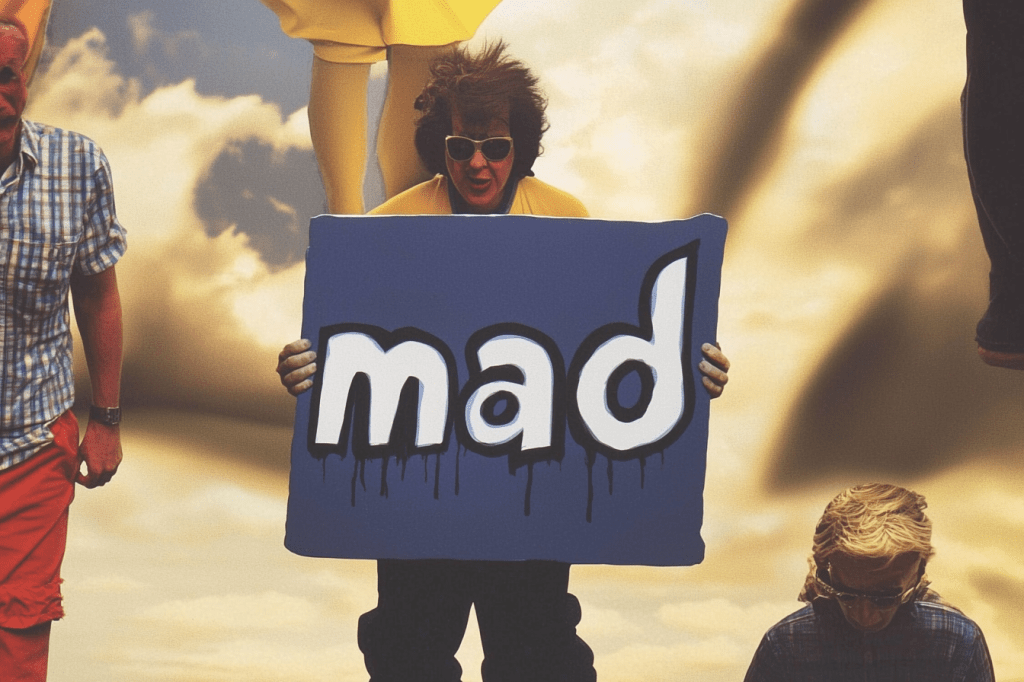
If what you are looking for is a concrete definition of madness, this isn’t your article. But chances are, especially if you are an adult, your definition of madness or psychosis is already fairly formed. Maybe it’s an image-based, archetypal, or totemic definition arrived at via material in film or other forms of media. Or maybe it’s an internal definition, wherein you hold your own actions as either mad or not and seek to improve. If you are authoritarian, it may be reactively obvious to you that madness is bad, the enemy of order. If you identify as anti-authoritarian, liberal, or as an activist, it’s also possible that you bravely view at least certain kinds of madness as being essential for progress in our human project.
This article aims to make elucidate for members of Misdiagnosed Anonymous some of our views on madness, the word, the concept, the action.
Lisa Archibald writes for Mad In America
The term “mad” has been reclaimed intentionally as a deliberate interruption or sabotage of the dominant psychiatric perspective. It challenges the entire basis of the medical framework which is that people have illnesses or disorders. Prior to the last 200 years in history, “madness” was a widely accepted term in society and was not a medical term. The reclamation of “mad” is a provocation to psychiatry as it is a complete rejection of their diagnostic expertise and power.
The Misdiagnosed identity is open to persons who identity as “mad” or as “mad activists”.
However, the mission of Misdiagnosed Anonymous is to fulfill a need for regular (occurring on a regular basis) mad-friendly support meetings. As much as we admire MadInAmerica, we have noticed a certain pattern where it comes to the keeping of regular meetings. There was Mad Summer Camp, long live Mad Summer Camp (it didn’t end up happening the year I wanted to go and no longer seems to be a regular occurence)! There was this incredible online poetry slam, billed as the first as if to indicate these might become regular occurrences. And yet there haven’t been so far. The organization is improving, and was recently rated as “Mostly Factual” by Media Bias Fact Check which is quite a bit more than we can say for the mainstream media’s reporting of The Star*d Study. We love Mad In America, and hope it continues doing what it does best: journalism, activism, sharp critiques of psychiatry, and speaking truth to power. However, it may very well be that regularly occurring support groups are not what fuels the kind of incisive journalistic viewpoints that MIA supports. And so, as a person who values the support group experience, how I do reconcile this?
Mad in America was founded by journalist Robert Whitaker after responding with admirable compassion when receiving feedback from misdiagnosed persons after his scorching expose / history of mental illness practice, a book by the same name. Whitaker was never himself misdiagnosed with a mental illness, or at least not by the mental health industry (spurious pharmaceutical-funded op-eds notwithstanding). Mad in America has a journalists ethics at its core, and quite frankly, from where we sit at Misdiagnosed Anonymous, deserves all the respect in the world.
Anyone can claim to be a “mad person” or a “mad activist” no matter their biography. And once claimed, they can also back away from this identity at any time and for any reason. Maybe they were being simply more generous than they had realized, or actually it wasn’t the political cause that speaks to them the most out of all the causes to choose from. As Misdiagnosed Persons, we appreciate the support, or the kind thoughts, or the… madness?
Misdiagnosis is a situation that seriously derails and disrupts the lives of those who it impacts, and can lead to the worst kind of trauma and self-negative thinking: the kind that many in power in our mental health care system would prefer to imagine doesn’t exist much less reserve empathy for. It is a concrete situation that is beyond exists within the relationship between the misdiagnosed person, their state, the Western institution of psychiatry (the DSM committee moreso than psychoanalysts and other factions that resist the biochemical model), and too often family members or “caregivers” who feel a sense of obligation to act as surrogates of state power. In its concreteness, it is beyond the power of the misdiagnosed person to escape from their situation, and as post Osheroff V Chestnut Diagnosis Theory’s illnesses are considered to be “lifelong”, despair and concomitant compliance are counted on as the only reasonable reactions. After misdiagnosis, any minor failure (we all fail before we succeed) and any minor misbehavior (we all misbehave at times, especially when we are young) are conflated by the system as proof that the misdiagnosed person “deserves” the punishment of their absurd situation.
Some days we get mad. Rage, even. Other days we’re just trying to make the best of our lives. Either way the system and our situation in it (by the very definition we have been ordered to accept) does not change. It is good to read articles supporting or clarifying our views or internal critiques of psychiatry. And yet, there remains an intense aloneness when we are not talking, sighing, hearing, communing on a regular basis with those who understood where we’re coming from, and those we understand.
We are inspired by many of the Twelve Step programs that exist today and their valuing of humanist, emotional, and moral inquiry and regular support. We are inspired to create a Twelve Step program that fits and our needs. For most of us, alcohol has been a major problem in our lives (many of us have avoided it early in life to avoid possible bad reactions and have never developed a habit with it or taste for it) so for obvious reasons we can’t attend AA. But like the blurring effects of alcohol, the malicious confusions of misdiagnosis have blurred us. At Misdiagnosis Anonymous we find solace, accountability, and truth when we hear others speak. And in our choice to commit, we discover courage, power, and the inspiration to live our best lives.
It is our hope that mad persons and mad activists feel welcome in our ranks. It also our hope that persons among us who enjoy order and regularity, accuracy, and organization feel equally welcome. We have a blog and are on the lookout for voices to join us in writing. But primarily, we believe in the liquid nourishment that is regular talking and sharing to relieve us where we have been so needlessly and desperately parched.
We value madness and appreciate its purpose. My madness and yours.
Structure and order also are deep values of ours, as we build an organization of real strength, real support, lasting kindness.
Though we all contain various parts, we are all fundamentally whole.
 Misdiagnosed Anonymous